What Is the Name of Commercial With the Baby Trying to Catch the Cat
| Domestic cat | |
|---|---|
 | |
| Diverse types of domestic cat | |
| Conservation condition | |
| Domesticated | |
Scientific classification  | |
| Kingdom: | Animalia |
| Phylum: | Chordata |
| Class: | Mammalia |
| Order: | Carnivora |
| Suborder: | Feliformia |
| Family: | Felidae |
| Subfamily: | Felinae |
| Genus: | Felis |
| Species: | F. catus[ane] |
| Binomial proper name | |
| Felis catus[1] (Linnaeus, 1758) | |
| Synonyms | |
| |
Cats, also called domestic cats (Felis catus), are small-scale, carnivorous mammals, of the family Felidae.[iii] [4]
Domestic cats are often called 'business firm cats' when kept as indoor pets.[5] Cats accept been domesticated (tamed) for nearly 10,000 years.[half dozen]
They are one of the most popular pets in the world. They are kept by humans for hunting rodents and as companions.
In that location are as well farm cats, which are kept on farms to keep rodents away; and feral cats, which are domestic cats that live abroad from humans.[7]
A cat is sometimes called a kitty. A young true cat is chosen a kitten.[8] A female true cat that has non had its sexual practice organs removed is called a queen. A male cat that has not had its sex organs removed is called a tom.
At that place are about sixty breeds of cat.[9] Domestic cats are constitute in shorthair, longhair, and hairless breeds. Cats which are not specific breeds can be referred to as 'domestic shorthair' (DSH) or 'domestic longhair' (DLH).
The word 'cat' is also used for other felines. Felines are usually called either big cats or small cats. The big, wild cats are well known: lions, tigers, leopards, jaguars, pumas, and cheetahs. There are small, wild cats in about parts of the world, such equally the lynx in northern Europe. The big cats and wild cats are non tame, and tin can exist very dangerous.
History [change | change source]
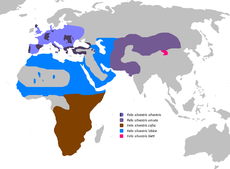
Past range of Felis silvestris.
In the past, most notably in Egypt, people kept domestic cats considering they hunted and ate mice and rats. Today, people often keep cats equally pets. There are also domestic cats which live without being cared for past people. These kinds of cats are called "feral cats".
The oldest evidence of cats kept as pets is from the Mediterranean island of Cyprus, effectually 7500 BC. Ancient Egyptians worshipped cats as gods, and often mummified them then they could be with their owners "for all of eternity".
Today, special food for cats is widely available in the developed countries. Proper feeding will aid a cat alive longer compared to hunting or existence fed table scraps. Not correctly feeding a cat can atomic number 82 to problems (see beneath for health concerns).
Cats cannot taste sweet foods (with sugar) because of a mutation (modify) in their ancestors which removed the ability to taste sweet things.
Cat anatomy [alter | alter source]
Cats have anatomy similar to the other members of the genus Felis. The genus has actress lumbar (lower back) and thoracic (chest) vertebrae. This helps to explain the cat's spinal mobility and flexibility. Unlike human arms, cat forelimbs are attached to the shoulder by free-floating clavicle bones. These let cats to pass their torso through any infinite into which they can fit their heads.[10]
The cat skull is unusual among mammals in having very big heart sockets and a powerful and specialized jaw.[eleven] :35 Compared to other felines, domestic cats accept narrowly spaced canine teeth: this is an adaptation to their preferred prey of small rodents.[12] Cats, like dogs, walk directly on their toes, with the bones of their feet making up the lower function of the visible leg.[13]
Cats walk very precisely. Unlike most mammals, when cats walk, they use a "pacing" gait (walking style); that is, they move the two legs on 1 side of the body before the legs on the other side. This trait is shared with camels and giraffes. Equally a walk speeds upwards into a trot, a cat's gait will modify to be a "diagonal" gait, similar to that of about other mammals: the diagonally opposite hind and forelegs will motility at the same time.[xiv] Most cats have 5 claws on their front paws, and four on their rear paws.[15] On the inside of the front paws in that location is something which looks like a sixth "finger". This special feature on the inside of the wrists is the carpal pad. The carpal pad is likewise found on other cats and on dogs.
Behaviour [alter | modify source]

The cat on the right is fed up with the cat on the left and this is a semi-serious alarm.

The stripes on this standard tabby true cat help information technology hide in long grass and bushes. It's a kind of cover-up.
Cats are active carnivores, meaning that in the wild they hunt live prey. Their main casualty is pocket-size mammals (similar mice). They will also stem, and sometimes kill and consume, birds. Cats eat a wide variety of prey, including insects such as flies and grasshoppers.[16] Their main method of hunting is stalk and pounce. While dogs accept great stamina and volition chase prey over long distances, cats are extremely fast, simply but over short distances. The bones cat coat colouring, tabby (see tiptop photo), gives it good cover-up in grass and woodland. The true cat creeps towards a chosen victim, keeping its body flat and near to the ground so that it cannot exist seen easily, until it is close plenty for a rapid dash or pounce. Cats, especially kittens, practise these instinctive behaviours in play with each other or on small toys. Cats tin can fish. They use a flip-upward motility of a forepart paw which, when successful, flips the fish out of h2o and over the true cat'due south shoulders onto the grass. Dutch research showed this to be an innate (inherited) behaviour pattern which developed early on and without maternal instruction.[17]
Cats are quiet and well-behaved animals, making them popular pets. Young kittens are playful. They tin can easily entertain themselves with a variety of shop-bought or homemade toys. Business firm cats have also been known to teach themselves to use lever-type doorknobs and toilet handles.[18]
Cats are fairly contained animals. They tin can look after themselves and exercise not need as much attention equally dogs practice.
Cats use many different sounds for advice, including meowing, purring, trilling, hissing, growling, squeaking, chirping, clicking and grunting.[nineteen]
Body posture is too important. The whole shape of the body changes when a cat is relaxed, or when it is alert. Also, the position of their ears and tail are used for communication, equally well as their usual functions.
These ways of communication are very important. They are used betwixt a mother cat and her kittens. They are also used between male and female cats; and between cats and other species, such as dogs. A mother cat protecting her kittens will fight off the largest dog. She gives good warning with a frightening display, hissing furiously, showing her claws, arching her back, and making her hair stand on end. If that fails, she attacks the dog's face up with her claws. Information technology has been said that no domestic dog ever tries such an attack a second time.[20]
Mating [modify | change source]
Cats just mate when the queen is "in heat". Heat periods occur nigh every two weeks and last iv to 6 days.[21] Mating in cats is a spectacular event. Several toms may exist attracted to a [queen] in heat. The males will fight over her, and the victor wins the correct to mate. At first, the female will decline the male, but somewhen the female will permit the male person to mate. The female will utter a loud yowl equally the male pulls out of her. This is considering a male cat's penis has a ring of about 120-150 backwards-pointing spines, which are about one millimeter long.[22] When the penis is withdrawn, the spines rake the walls of the female person's vagina, which is a trigger for ovulation.[23] Later on mating, the female will wash her vulva thoroughly. If a male attempts to breed with her at this point, the female will attack him. Later on most 20 to 30 minutes. one time the female person is finished grooming, the bicycle volition echo.[21]
Considering ovulation is non always triggered, females may not become significant by the first tom which mates with them.[24] A queen may mate with more than one tom when she is in rut, and unlike kittens in a litter may have dissimilar fathers.[21] The bicycle ceases when the queen is significant.
The gestation period for cats is nigh two months, with an boilerplate length of 66 days.[25] The size of a litter is normally three to five kittens. Kittens are weaned at betwixt six and seven weeks, and cats normally achieve sexual maturity at 5–10 months (females) and to 5–seven months (males).[21] Females can have two to iii litters per twelvemonth, so might produce up to 150 kittens in their breeding life of about ten years.[21]
Birth and after [change | modify source]
Significant queens evangelize their litters by themselves, guided past instinct. The queen finds the safest place she tin can. And so she will clean it thoroughly, with her tongue, if necessary. Here she will quietly give birth. She licks the newborn kits clean. In the wild, leaving a odour is risking a unsafe encounter with other animals. The kits are born blind and with closed optics. They suckle on her teats, and sleep a good bargain. After 2 weeks or so, their optics open. At that phase they have blueish eyes, but non the best sight. A scrap subsequently, the best developed kit will totter out of the nest. The others follow. They will soon recognise y'all as a living thing: that is a great moment. At starting time, they go dorsum to the nest to feed and sleep. Afterwards some more days they exit the nest for expert, only still they may slumber together in a 'kitten heap'.
The queen, meanwhile, has left the nest from fourth dimension to time, to hunt, feed, and too to urinate and defecate. Dissimilar the tom, she covers up her business to hide her scent. Very soon, the kits will urinate anywhere they please unless one trains them. This is done after they are weaned, when they are ready for some kitten nutrient. Here is how to practise it:
- ane. Prepare clean cat tray filled with absorptive grit.
- ii. Give kittens their special kitten food.
- 3. Take the lead kitten right after it has eaten, identify it in your cat tray.
- 4. Gently stroke its tummy with i finger.
- 5. Spotter every bit kitten sits down promptly and urinates. Do aforementioned for other kits.
- 6. Repeat next time if they demand it. They will not demand a third time.
What you have done is exactly what the queen would do in the wild. You have triggered a reflex which all kittens have. The affair is, the tray is artificial, and your queen may do her business outside. But at least when young, kittens need a tray. Your next job is to call the vet, who volition tell yous when to bring the kits for their vaccination.[26]

Kittens play endlessly. Information technology is how they do their learning. They will play their favourite games, such as 'hide and pounce', with nigh anyone or annihilation. Soft balls on strings are a standard toy; so is a scratching post.
With cats there is a limit to how far you can train them. They are at least as intelligent as dogs, but they are not pack animals. They like to do their own thing, and owners exercise all-time past plumbing fixtures in. Never hit a cat: if yous practise, the relationship will never be the same once more. If you really want to dissuade them, try hissing. It has been said that no 1 actually owns a true cat; many cats collect extra owners, and may alter firm if they practice not like the treatment...[27]
If your kitten was born in your home practise not let information technology out of the business firm until information technology is two to three months old. If y'all have the mother, she will look after the kit. Simply if you accept got the kit from a vet or dealer, keep it in for several weeks. When it does go out, you need to watch over it. The chief trouble is that information technology may easily get lost. In time, the kit will acquire every inch of the house and garden. Then, you can happily let it roam.[28]
Grooming [alter | change source]
Cats are very clean animals. They groom themselves past licking their fur. The cat's tongue tin act as a hairbrush and can make clean and untangle a cat'southward fur. Nonetheless, owners may buy grooming products to help the cat accept intendance of itself. Subsequently licking their fur, cats sometimes go hairballs.[29] A hairball is a modest corporeality of fur that is vomited up by animals when it becomes also big. This is quite normal. Owners brush their cats to attempt to prevent a lot of hairballs.
Nutrient [modify | change source]

A typical dark-brown Burmese cat
Many house cats consume nutrient which their owners give them. This food is manufactured, and designed to contain the right nutrients for cats. There are many dissimilar types of true cat food. These come in many different flavors and costs are often very small.
In that location is moist canned food and also dry cat food which comes in dissimilar sized cans or bags and formulas. At that place are kitten formulas, cat formulas, health formulas, formulas for reducing a true cat'south weight, and many others. It seems obvious that the food should be mostly meat, as that is most of a true cat'southward natural diet. But remember, when they catch mice, they also consume the bones. So at that place is need for formulas to take more than just meat.
Cats should not be fed a daily diet of dog food. It could brand the cat bullheaded, as it has no taurine, which is a nutrient for the optics.
Wellness concerns [modify | change source]
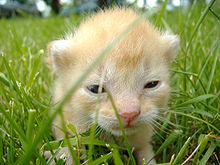
A very young kitten. This kitten has been taken out of the nest for a photograph; its optics are just open, just it cannot all the same see properly.

Cats do get diseases, and prevention is ameliorate than cure. It is most important to become a immature cat vaccinated against some of the most deadly diseases. If a true cat gets a disease, a veterinary (beast doctor) can offering assist. Some cats, depending on breed, gender, age, and general health, may be more susceptible to affliction than others. Regular visits to a vet tin keep a cat alive many extra years by catching sickness and disease early on.[30]
Cats that roam outside will get fleas at some time. Cat fleas will not alive on people, only fleas volition not hesitate to bite anyone nearby. Owners may choose to buy anti-flea collars, simply any areas where the cat unremarkably sleeps need to exist cleaned up. A vet or local pet-store may offer advice about fleas. It is recommended that people speedily have action when a true cat gets fleas because fleas can make cats uncomfortable.
House cats tin become overweight through lack of exercise and over-feeding. When they get spayed or neutered ("fixed"), they tend to exercise less. Spaying is done for queens, and neutering is done for toms. It is important to fix cats, and here are some reasons. Starting time of all, if a female person cat has kittens, they will need homes. Finding homes for kittens is oftentimes quite difficult. If a tom is non fixed, it develops a disgusting odour. Breeders who have unabridged toms continue them in a special hut exterior the house, for that reason. Fixing besides helps to avoid over-population. Over-population means that there are too many cats, and some will be put to sleep (put downwards) in animal pounds (animal shelters).
Information technology is a practiced idea to adopt a true cat from a vet or an beast shelter. The vet, shelter or RSPCA will make sure they are good for you and spayed.[31] [31]
Kittens are sometimes born with defects. People who receive cats as gifts are recommended to get information technology examined for its wellness. Some birth defects need attending. Others are harmless, like polydactyly. Polydactyly means many digits, or many "fingers" from poly (many) and dactyl (digit). Sometimes, there is a mutation (change) in cat families. Most cats accept but iv to five toes per paw, depending on whether it is the forepart or back paw. These mutated cats accept vi, 7, and in rare cases even more. All of these cats are called polydactyl cats. They tin can also be called Hemingway cats considering author Ernest Hemingway owned some of these cats.
References [change | change source]
- ↑ Linnaeus, C. (1758). "Felis Catus". Systema naturae per regna tria naturae: secundum classes, ordines, genera, species, cum characteribus, differentiis, synonymis, locis (in Latin). Vol. 1 (Tenth reformed ed.). Holmiae: Laurentii Salvii. p. 42.
- ↑ Erxleben, J. C. P. (1777). "Felis Catus domesticus". Systema regni animalis per classes, ordines, genera, species, varietates cvm synonymia et historia animalivm. Classis I. Mammalia. Lipsiae: Weygandt. pp. 520–521.
- ↑ Linnaeus, C. (1758). "Felis Catus". Systema naturae per regna tria naturae: secundum classes, ordines, genera, species, cum characteribus, differentiis, synonymis, locis (in Latin). Vol. one (Tenth reformed ed.). Holmiae: Laurentii Salvii. p. 42.
- ↑ Wozencraft, West. C. (2005). "Species Felis catus". In Wilson, D. E.; Reeder, D. M (eds.). Mammal Species of the World (3rd ed.). Johns Hopkins University Press. pp. 534–535. ISBN978-0-8018-8221-0. OCLC 62265494.
- ↑ Clutton-Brock, J. (1999) [1987]. "Cats". A Natural History of Domesticated Mammals (2d ed.). Cambridge, England: Cambridge University Press. pp. 133–140. ISBN978-0-521-63495-3. OCLC 39786571.
- ↑ "Oldest known pet cat? 9500-year-old burial found on Cyprus". National Geographic News. 2004-04-08. Retrieved 2007-03-06 .
- ↑ Liberg, O.; Sandell, 1000.; Pontier, D. & Natoli, Eastward. (2000). "Density, spatial organisation and reproductive tactics in the domestic cat and other felids". In Turner, D. C. & Bateson, P. (eds.). The domestic cat: the biology of its behaviour (2d ed.). Cambridge: Cambridge University Press. pp. 119–147. ISBN9780521636483.
- ↑ "Kitten development: when does a kitten get a true cat?". world wide web.whiskas.co.great britain . Retrieved 2021-05-03 .
- ↑ Driscoll, C. A.; Clutton-Brock, J.; Kitchener, A. C. & O'Brien, S. J. (2009). "The taming of the cat". Scientific American. 300 (half-dozen): 68–75. Bibcode:2009SciAm.300f..68D. doi:10.1038/scientificamerican0609-68. PMC5790555. PMID 19485091.
- ↑ Gillis, Rick, ed. (22 July 2002). "Cat skeleton". Zoolab: a website for creature biology. La Crosse, WI: Academy of Wisconsin. Archived from the original on six December 2006. Retrieved 7 September 2012.
- ↑ Case, Linda P. (2003). The cat: its behavior, nutrition, and health. Ames, IA: Iowa State University Pr. ISBN0-8138-0331-four.
- ↑ Smith, Patricia; Tchernov, Eitan (1992). Construction, function and development of teeth. Freund Publishing House Ltd. p. 217. ISBN965-222-270-4.
- ↑ Lacquaniti, F.; Grasso, R.; Zago, One thousand. (1999). "Motor patterns in walking". News Physiol. Sci. 14 (4): 168–174. doi:10.1152/physiologyonline.1999.14.4.168. PMID 11390844.
- ↑ Christensen, Wendy (2004). Outwitting cats. Globe Pequot. p. 23. ISBN1-59228-240-7.
- ↑ Danforth, C.H. (1947). "Heredity of polydactyly in the cat" (PDF). Periodical of Heredity. 38 (iv): 107–112. doi:x.1093/oxfordjournals.jhered.a105701. PMID 20242531.
- ↑ Pond G. & Dineen J. The family library of cats. London: Octopus, p47.
- ↑ Morris D. 1986. Catwatching: the essential guide to cat behaviour. London: Cape, p72/three.
- ↑ Nick Sayer (19 April 2006). "Gizmo Flushes" – via YouTube.
- ↑ "Meows mean more than to cat lovers". Channel3000.com. Archived from the original on 2003-08-04. Retrieved 2006-06-14 .
- ↑ Konrad Lorenz 1950. Man meets dog.
- ↑ 21.0 21.1 21.2 21.3 21.iv "Prolific cats: the estrous wheel" (PDF). Veterinarian Learning Systems. Archived from the original (PDF) on six December 2019. Retrieved nineteen June 2009.
- ↑ Aronson Fifty.R. & Cooper M.L, LR (1967). "Penile spines of the domestic cat: their endocrine-behavior relations" (PDF). Anat. Rec. 157 (1): 71–viii. doi:x.1002/ar.1091570111. ISSN 0003-276X. PMID 6030760. S2CID 13070242. Archived from the original (PDF) on 2017-06-xx. Retrieved 2009-10-01 .
- ↑ Trigger: in the sense of an upshot which starts other events.
- ↑ Wildt D.East; Seager South.West. and Chakraborty P.K., DE (1980). "Effect of copulatory stimuli on incidence of ovulation and on serum luteinizing hormone in the true cat". Endocrinology. 107 (4): 1212–7. doi:ten.1210/endo-107-4-1212. ISSN 0013-7227. PMID 7190893. ; CS1 maint: multiple names: authors list (link)
- ↑ Tsutsui T. and Stabenfeldt G.H (1993). "Biology of ovarian cycles, pregnancy and pseudopregnancy in the domestic true cat". J. Reprod. Fertil. Suppl. 47: 29–35. ISSN 0449-3087. PMID 8229938.
- ↑ How to look after your cat: there are ii books with this title, as follows. 1. by Colin and Jacqui Hawkins, Walker Books, 1996. two. by Alan Edwards, Southwater, 2006.
- ↑ Gallico, Paul. The silent miaow: a true cat's eye view of Human being sapiens. Heinemann, London.
- ↑ Behrend, Katrin & Wegler, Monika; translated from High german by Elizabeth D. Crawford. (1991). The Complete Book of Cat Care: how to raise a happy and healthy cat. Hauppauge, NY: Barron's Educational Series, Inc. ISBN0-8120-4613-7.
{{cite book}}: CS1 maint: multiple names: authors list (link) - ↑ http://cats.nigh.com/cs/catmanagement101/a/hairballs.htm Merely note: this ref overstates the problem.
- ↑ [Anon.] 1983. Sherley'due south cat book: the complete book of cat care written by a vetinary surgeon. Ashe Laboratories, Leatherhead, Surrey.
- ↑ 31.0 31.ane "Why y'all should spay/neuter your pet". The Humane Social club of the U.s.a. . Retrieved 2019-03-21 .
Source: https://simple.wikipedia.org/wiki/Cat
0 Response to "What Is the Name of Commercial With the Baby Trying to Catch the Cat"
Enregistrer un commentaire